The Rogue River Estuary: Elephant Bar Habitat Enhancement
Curry Anadromous Fishermen were honored to welcome Kelly Timchak of Curry Watersheds Partnership to present at our recent General Meeting. Her presentation highlighted ongoing habitat restoration efforts in the Rogue River Estuary, focusing on projects designed to improve critical rearing habitat for juvenile salmonids such as Chinook and coho salmon, steelhead, and Pacific lamprey.
These restoration initiatives aim to reconnect floodplain habitats, enhance tidal slough channels, and improve water quality and shelter—key factors in supporting the long-term recovery and survival of native fish populations in the Lower Rogue River.
Continue reading to explore Kelly’s presentation.
The Rogue River Estuary is the vital interface between ocean and freshwater that is critical to the health and survival of numerous threatened and listed anadromous species such as coho and Chinook salmon, steelhead trout, and Pacific lamprey. The estuary provides a nursery and transition area for juvenile salmonids. The estuary was determined to be a limiting factor to salmonid health based on the extensive physical and hydrologic modifications that have occurred in the past and the subsequent impacts to available aquatic habitat and water quality. According to the SONCC Recovery Plan, current limiting factors for the Lower Rogue River are lack of floodplain and channel structure, impaired water quality (mainly temperature), and impaired estuarine function. The leading limiting factor for salmonids in the Lower Rogue River is the lack of suitable habitat for the juvenile rearing phase, and the SONCC Recovery Plan notes that recovery is extremely unlikely without additional summer and winter habitat. The following proposed suite of habitat restoration projects are specifically focused on increasing access to high quality off-channel refugia (winter habitat) and access to cold water refugia (summer habitat) for juveniles.
Several studies in Oregon have shown that estuarine tributaries and sloughs are some of the most important habitat types for rearing coho salmon.
Native fish utilizing God Wants You (GWY) Slough include juvenile Chinook and steelhead and both juvenile and adult cutthroat and coho. The estuarine reach of the Rogue River plays a critical role in the growth and survival of these species as well as of green and white sturgeon and Pacific lamprey. Insufficient suitable rearing habitat for juveniles is considered the most significant limiting factor for recovery of coho. The principal recommendations from the federal coho recovery plan include the need to reconnect and restore wetland and backwater habitats, increase instream structure through addition of large wood and re-establishment of riparian forests for wood recruitment and water temperature reduction.
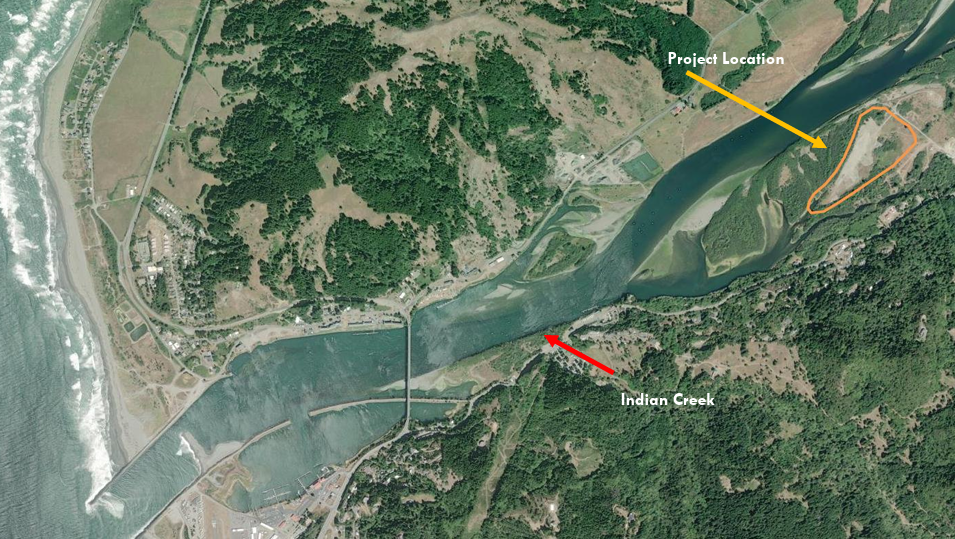
The proposed implementation work occurs in the Rogue River estuary, and consists of constructing new tidal and intertidal slough channel salmonid habitat on Elephant Bar located within the Rogue River Estuary. The project site is owned and operated as a gravel mining operation by Freeman Rock and is located between the Rogue River and God Wants You (GWY) Slough along the south bank of the river near River Mile 2.6. The portion of Elephant Bar occupied by the gravel mining pit currently experiences flow only during winter runoff events and is almost completely lacking in vegetation cover or large wood. In contrast, the adjacent GWY Slough provides excellent low-velocity rearing habitat for juvenile salmonids, contains good riparian cover, and has some natural large wood elements as well as numerous large wood structures that were installed by the LRWC as part of a previous restoration project.
The principal goal of this project is to extend the high-value habitat of GWY Slough into the central portion of Elephant Bar through excavation of new slough channels. Instream structure, complexity, and shelter will be created through development of diverse geomorphic features and incorporation of large wood structures, and a diverse assemblage of riparian vegetation will be established which will promote shading and cooler water temperatures. Additional project goals are to ensure continued connectivity and fish passage between created slough channels and GWY Slough and to avoid post-project habitat degradation due to excessive erosion or deposition to the extent possible.
Project partners include O’Connor Environmental, Curry SWCD, Confederated Tribes of the Siletz Indians, Nvn-nes-‘a Land Trust, BLM, USFS, USFWS, Bandon Dunes Charitable Foundation, and ODFW. Please reach out to Kelly Timchak, Lower Rogue Watershed Council Coordinator at kelly@currywatersheds.org or 541-373-0057 with any questions.
Elephant Bar Habitat Creation Presentation
Elephant Bar Habitat Construction Plan
To learn more about Curry Watersheds Partnership, click the image or the link below: